Four sets of miniature decanter centrifuges have been shipped to a European client for solid-liquid separation in mineral exploration slurry processing. This delivery, completed by Hebei GN Solids Control Co., Ltd., represents a significant expansion of China’s high-end environmental separation equipment into the European market. The systems are designed to provide an efficient, stable, and intelligent solution for handling fine-particle slurries, a common challenge in exploration and environmental remediation.
The delivered equipment consists of the GNLW223D-VFD variable frequency drive decanter centrifuge, paired with a primary GNZS752F-MDZF vibrating screen to form a two-stage separation process. Each centrifuge is a fully hydraulic-driven, industrially-rated unit with a designed processing capacity of 10 cubic meters per hour. It is particularly suited for suspensions with low solid content and fine particle size. A key performance metric is its separation factor of 2492 G, enabling effective separation of particles as fine as 2 to 5 micrometers in diameter. This surpasses the typical lower limit of 10-20 micrometers for standard industrial centrifuges, making it highly effective for difficult-to-process sludges and wastewater residues. This high performance is achieved through a precisely engineered bowl structure and advanced dynamic balancing, ensuring smooth operation at high speeds, which extends service life and reduces maintenance frequency.
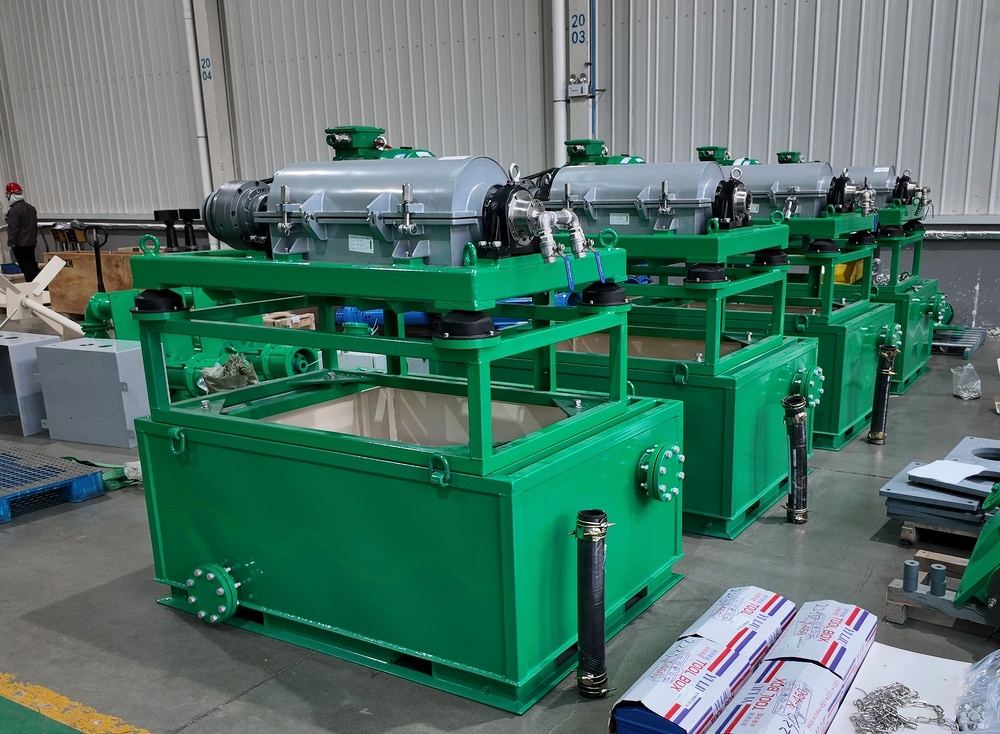
Core components are constructed with premium international materials to ensure long-term reliability under demanding conditions. The centrifuge bowl is made from SS2205 duplex stainless steel, offering high corrosion resistance and strength for handling acidic, saline, or oily media. Critical wear areas on the conveyor screw are protected with tungsten carbide inserts, improving abrasion resistance by three to five times and significantly extending maintenance intervals. The bearing system utilizes original imported products from SKF and NSK, guaranteeing precision and low-noise operation during continuous 24/7 duty. The integrated control system employs PLCs from Siemens and ABB, enabling real-time monitoring, automatic parameter adjustment, and remote diagnostics. Functions include fault alarms, operational data logging, and energy consumption statistics, meeting European requirements for intelligent and digital equipment management. The system features automated feed control, differential speed adjustment, and feedback control for solid-phase dryness, allowing for straightforward operation with minimal technical supervision.
The two-stage “screen + centrifuge” process is optimized for efficiency and equipment protection. The primary vibrating screen, equipped with a high-standard composite screen panel, effectively removes large particles and debris above 100 micrometers. This pre-treatment reduces the load on the centrifuge, minimizes wear, and prevents potential blockages. The screen panel features a quick-release design, cutting replacement time by over 50 percent, which aligns with European operational standards emphasizing maintainability and minimal downtime. The secondary decanter centrifuge then performs the fine separation, dewatering the pre-screened slurry to a solid phase with a moisture content typically below 30 percent. This facilitates the recovery of solids and the discharge of clarified liquid. This combined process, validated in multiple overseas projects, can increase overall system efficiency by more than 20 percent and extend the centrifuge’s operational life by over 30 percent.
The compact footprint of the system makes it suitable for space-constrained installations common in European urban wastewater treatment plants, pharmaceutical facilities, or food processing plants. Its sealed design prevents leaks and odor emissions, ensuring compliance with EU environmental standards such as EN 12573 and ISO 14001. Energy consumption is optimized through the variable frequency drive, which allows the motor speed and conveyor differential to adjust automatically based on feed concentration, reducing specific energy use by 15 to 20 percent. The modular hydraulic drive system is robust enough to perform reliably in diverse climatic conditions, from Northern European winters to Southern European summers. The dryness of the discharged solids is adjustable, supporting various downstream handling, drying, or resource recovery processes according to client needs.
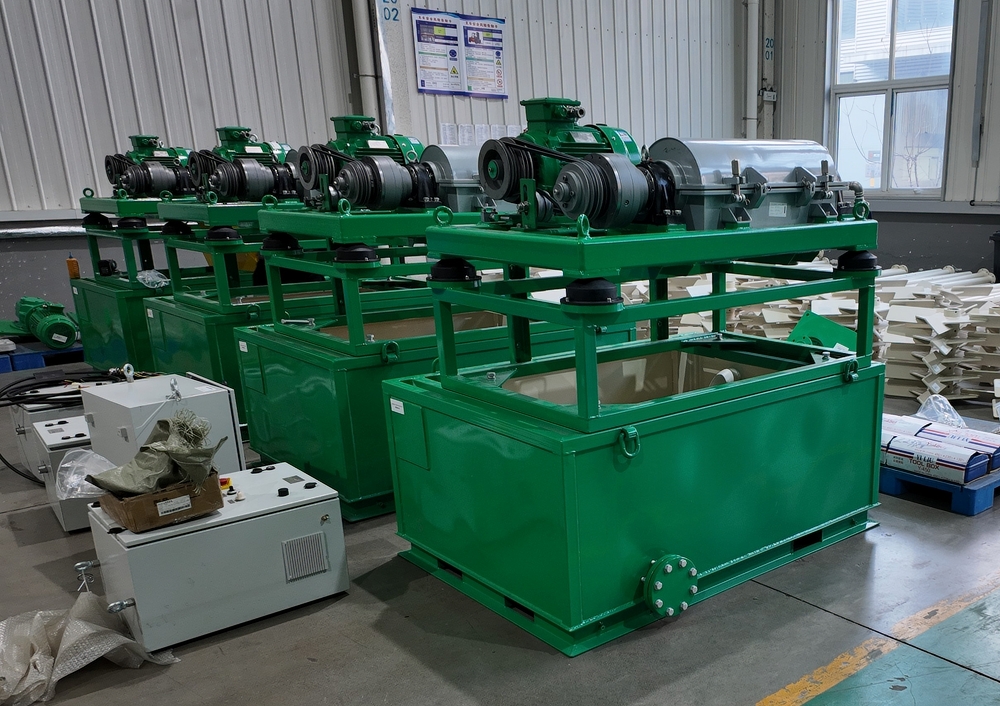
The technology behind the decanter centrifuge is based on centrifugal sedimentation. The slurry is fed into a high-speed rotating conical bowl. Under intense centrifugal force, denser solid particles settle against the bowl wall, while the clarified liquid forms an inner layer and is discharged via an overflow weir. A conveyor screw, rotating at a slightly different speed, continuously moves the settled solids toward the discharge end. This is a continuous, filterless physical separation process, eliminating the need for consumable filter media and aligning with European principles of green manufacturing and circular economy.
Although classified as a “miniature” model, its core performance parameters rival those of larger units. For instance, its separation factor is comparable to many mid-sized industrial centrifuges. The bowl’s diameter, length, and aspect ratio are optimized through fluid dynamics simulation to maintain high separation efficiency even at the rated lower flow rate, preventing short-circuiting of the feed. The entire assembly undergoes high-speed dynamic balancing, achieving vibration levels below the ISO 1940 G2.5 standard, a key factor in earning client confidence.
This shipment of four systems is not merely a product export but reflects the alignment of Chinese manufacturing standards with international benchmarks. The entire production process, from material sourcing and component manufacturing to final assembly, testing, and painting, adheres to the ISO 9001 quality management system. The equipment fully complies with relevant EU directives, including the Machinery Directive 2006/42/EC and the Low Voltage Directive 2014/35/EU, and carries CE certification. The repeat order from a well-established European environmental engineering company underscores strong client trust in the product’s quality, technical support, and after-sales service.
In summary, the delivery of these four miniature decanter centrifuge systems to Europe marks a milestone in the internationalization of China’s high-end environmental separation technology. By combining high separation precision, intelligent control, durable construction, low operational costs, and a compact design, the equipment precisely meets the European market’s demand for efficient, small-to-medium-scale solid-liquid separation solutions. Its application will support advanced processing in areas like mineral exploration slurry treatment, industrial wastewater purification, and waste stream recovery. This case demonstrates the evolving capability of Chinese equipment manufacturing to provide customized, intelligent, and environmentally compliant solutions for the global high-end market.