Tailings management is one of the most pressing operational and environmental challenges in mining and mineral processing. As ore grades decline and regulatory pressure on tailings storage facilities increases, operators need dewatering equipment that can handle large volumes of fine-grained slurry continuously and reliably. Decanter centrifuges, particularly large-bowl models, have become a standard solution for this duty. This article examines why large-bowl decanter centrifuges are suited to tailings dewatering and what specific design features matter in practice.
Tailings are not a uniform material. They typically contain a wide particle size distribution, a significant fraction of fines below 20 microns, and variable mineralogy that affects settling behavior. Traditional separation methods—gravity settling, magnetic separation, and flotation—were not designed for the volumes and fine particle content that modern mining operations generate. Gravity thickeners can recover water but produce a underflow that still contains substantial moisture. Filter presses achieve high dryness but operate in batches and struggle with high-clay or slimy feeds. The result is that many operations face a bottleneck: they can move ore, but they cannot economically manage the waste stream.
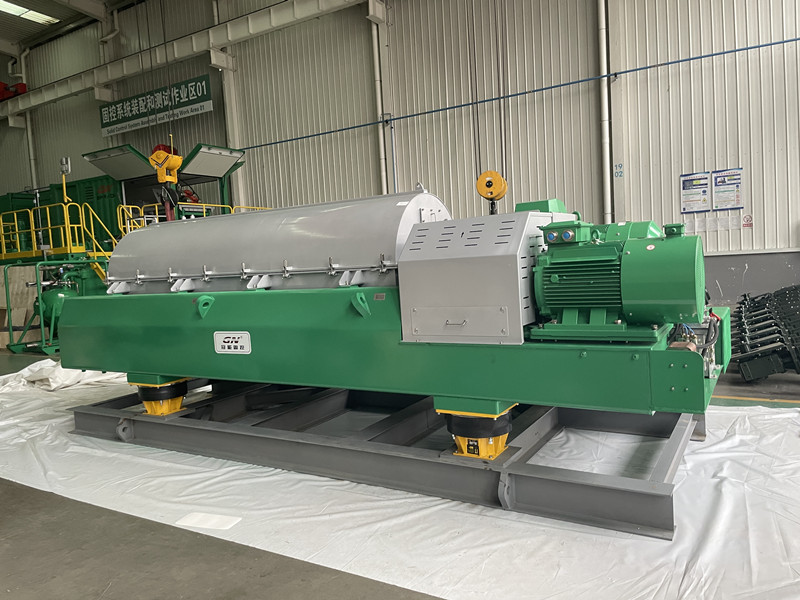
A decanter centrifuge addresses this bottleneck by applying centrifugal force to accelerate settling. The unit consists of a rotating cylindrical-conical bowl and an internal scroll that rotates at a slightly different speed. Slurry enters through a feed tube, is accelerated to bowl speed, and the solid phase settles against the bowl wall under centrifugal force. The scroll conveys the settled solids toward the conical end for discharge, while clarified liquid exits at the cylindrical end. Because the process is continuous, the centrifuge can operate around the clock with minimal operator intervention.
The term “large bowl” refers to the diameter and length of the rotating assembly. A larger bowl diameter increases the settling area and the depth of the liquid pool, which improves separation of fine particles. A longer bowl increases the residence time of the slurry, allowing more complete settling. In tailings applications, where a substantial portion of solids may be in the 2–10 micron range, these two parameters directly determine performance.
Consider a representative large-bowl model with a 760 mm bowl diameter and a length of roughly 3,300 mm. The maximum rotational speed is approximately 2,650 rpm, generating a centrifugal force of about 3,000 G. At this G-level, particles that would take hours to settle under gravity settle in seconds. The theoretical cut point—the particle size at which separation efficiency is 50%—can reach 2 to 5 microns, depending on feed characteristics and operating parameters. This is a critical threshold: it means the centrifuge can capture fines that would otherwise report to the liquid phase and return to the process or require further treatment.
Throughput is equally important. A large-bowl unit can process up to 120 cubic meters per hour, which matches the output of a mid-to-large-scale mineral processing plant. The differential speed between bowl and scroll is adjustable, typically in the range of 5 to 28 rpm. This adjustability allows the operator to trade off between solids dryness and liquid clarity. A lower differential speed increases the solids residence time in the bowl, producing drier cake, while a higher differential speed improves liquid clarity by reducing the solids load in the pool.
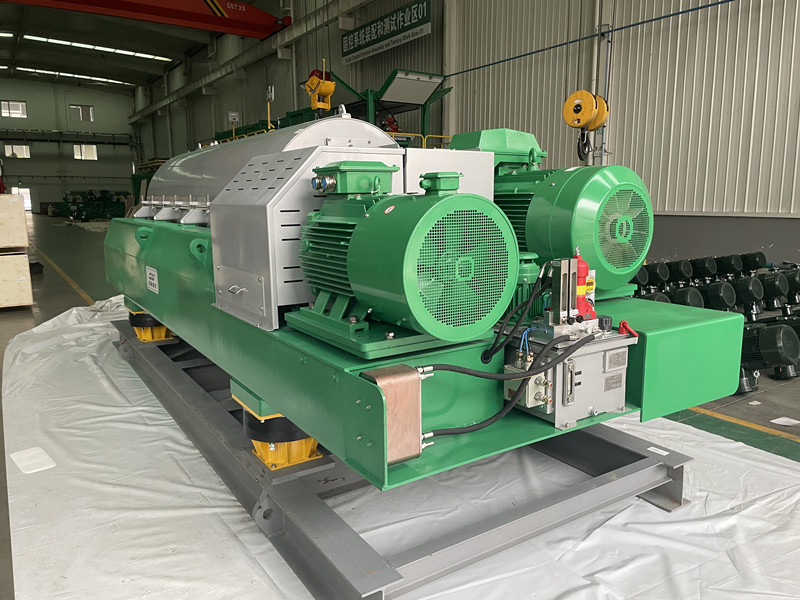
Modern decanter centrifuges for tailings duty are equipped with variable frequency drives on both the main motor and the backdrive motor. This configuration allows independent control of bowl speed and differential speed, which is essential when feed properties change. For example, if the feed becomes finer or more viscous, the operator can reduce the differential speed to maintain solids dryness, or increase bowl speed to maintain liquid clarity. The ability to adjust these parameters in real time without shutting down the machine is a significant operational advantage over batch processes.
Power requirements reflect the scale of the machine. A large-bowl unit may use a 160 kW main motor and a 90 kW backdrive motor. While these figures appear high, the energy consumption per cubic meter of feed is often lower than that of filter presses when the entire cycle—including feed pumps, filter cloth replacement, and batch downtime—is accounted for.
Tailings slurries are abrasive. The presence of quartz, feldspar, and other hard minerals accelerates wear on the scroll flights and the bowl interior. For this reason, large-bowl decanters intended for mining service use wear-resistant materials. Duplex stainless steel 2304 is a common choice for the bowl and scroll body, offering a combination of corrosion resistance and mechanical strength. The scroll flights are often hard-surfaced or fitted with tungsten carbide tiles at the points of highest wear. Bearing selection also matters: SKF or equivalent bearings are standard to ensure reliability under continuous operation.
A decanter centrifuge is rarely installed as a standalone unit. In tailings dewatering, it is part of a system that includes feed pumps, flocculant dosing equipment, and conveyance for the dewatered cake. Modular containerized designs have become popular for remote or overseas projects. In this arrangement, the centrifuge is mounted on a steel frame within a shipping container, with the polymer dosing unit located below or adjacent. The container includes walkways, lighting, and ventilation, allowing the system to be commissioned quickly on site. This approach reduces civil works and shortens the timeline from delivery to operation.
Flocculant addition is often necessary when the tailings contain a high proportion of clay or ultrafine particles that resist centrifugal settling alone. The polymer bridges fine particles into larger flocs, which are then captured by the centrifuge. The feed system must introduce the flocculant with sufficient mixing energy to promote floc formation but without excessive shear that would break the flocs apart. Some designs use a gentle feed accelerator to minimize shear, which improves flocculation efficiency and reduces polymer consumption.
The primary outputs of tailings dewatering are a clarified liquid stream and a dewatered solids stream. The clarified liquid, often called centrate, can be returned to the process as wash water or make-up water. In many operations, this reduces fresh water intake by 70% or more, which is significant in arid regions or where water rights are constrained. The dewatered solids, typically in the range of 60–75% solids by weight depending on feed characteristics, can be conveyed to a dry stack. Dry stacking eliminates the need for a tailings dam, removing the risk of dam failure and the long-term liability of impoundment maintenance. It also allows progressive reclamation of the disposal area.
There is also a resource recovery angle. In tailings that contain residual metals or heavy minerals, the centrifuge concentrates these values in the solids stream. While the centrifuge is not a substitute for a full recovery circuit, it can improve the economics of downstream processing by reducing the volume of material that must be treated.
Selecting a large-bowl decanter for tailings duty requires attention to several factors beyond the machine itself. Feed characterization—particle size distribution, solids concentration, mineralogy, and rheology—should be conducted before sizing. Pilot testing is advisable when the tailings are unfamiliar or when the target dryness is aggressive. The control system should allow for automatic adjustment of differential speed based on torque or solids load, which reduces operator workload and protects the machine from overload. Finally, maintenance access should be considered at the design stage: bowl removal and scroll inspection require space and lifting equipment.
Large-bowl decanter centrifuges have become a practical and widely adopted solution for tailings dewatering. Their continuous operation, high throughput, and ability to capture fine particles make them suitable for the volumes and material characteristics typical of modern mining operations. When integrated with flocculant dosing and containerized packaging, they offer a deployable system that reduces water consumption, eliminates tailings dams, and lowers long-term environmental risk. For operations facing tightening regulations and rising water costs, the large-bowl decanter is not merely an option but a core component of the tailings management strategy.