The GN-14 inch sludge dewatering centrifuge, a core product of Guanneng Separation and Conveying Equipment Co., Ltd., represents a significant advancement in solid-liquid separation technology for industrial and municipal wastewater treatment. This article will detail the working principle and performance characteristics of this centrifuge, focusing on its application in a system with a 1000L chemical dosing capacity, as recently delivered to a Southeast Asian client.
At its core, the GN-14 inch centrifuge, model GNLW363D-VFD, is a decanter centrifuge designed for continuous operation. Its primary function is to separate solid particles from liquid sludge, significantly reducing volume and weight for disposal. The process begins with the feed sludge, which is first conditioned with flocculants. In a typical 1000L dosing system, polymer solutions are prepared in dedicated tanks and then precisely injected into the sludge stream via metering pumps. This conditioning agglomerates fine solid particles into larger flocs, dramatically improving their separation characteristics within the centrifuge.
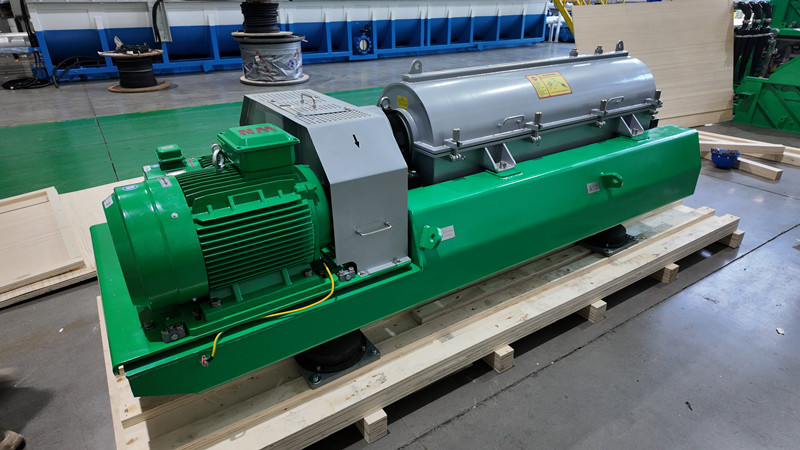
The conditioned sludge is then fed into the centrifuge through a stationary inlet pipe. Inside the rotating assembly, separation occurs due to centrifugal force. The centrifuge consists of two main components: a conical cylindrical bowl (the “rotating bowl”) and a scroll conveyor (the “screw”), both rotating at high speeds but with a slight differential. The bowl, with a 14-inch (approximately 355mm) diameter, spins at a variable speed, typically up to 3900 RPM, generating a high centrifugal force field. Under this force, the denser solid flocs are thrown against the bowl’s inner wall, while the clarified liquid, or centrate, forms an inner layer.
The key to continuous operation is the differential speed between the bowl and the scroll. The scroll rotates slightly slower than the bowl. This speed difference causes the scroll to act like a screw, gently conveying the settled solids along the conical section of the bowl toward the discharge ports. This area is often called the “beach,” where further dewatering occurs as the solids are lifted out of the pond of liquid and expelled. Meanwhile, the clarified centrate flows over adjustable weirs at the opposite end of the bowl and is discharged separately. This continuous feed, separation, and discharge process allows for high throughput with minimal operator intervention.
The performance of this system hinges on several key factors. First, the dewatering efficiency is paramount. The GN-14 inch model is engineered to produce a cake with a dry solids content typically between 60% and 75%, a substantial improvement over traditional methods like belt filter presses. This high dryness directly translates to lower transportation and disposal costs. Second, solid recovery rate is critical. The combination of effective polymer dosing from the 1000L system and the precise control of the centrifuge’s parameters ensures a high capture of solids, resulting in a clear centrate that often meets standards for return to the treatment process or discharge.
A major performance feature is its operational flexibility and control, enabled by the Variable Frequency Drive (VFD). Operators can independently and continuously adjust two critical parameters: bowl speed and differential speed. The bowl speed controls the centrifugal force; a higher speed increases separation force for finer particles but also increases energy consumption. The differential speed controls the residence time of solids in the bowl; a lower differential allows solids more time to compact, yielding a drier cake, while a higher differential increases throughput. For the 1000L dosing system, this means the centrifuge can be finely tuned to match the specific characteristics of the sludge and the effectiveness of the chemical conditioning, optimizing performance for varying feed conditions without hardware changes.
Durability and maintenance are built into the design for harsh environments like those in Southeast Asia. The rotating components are constructed from high-grade stainless steel for corrosion resistance. The scroll conveyor, which experiences severe abrasive wear, is protected in critical areas with tungsten carbide hard-facing or replaceable alloy liners, extending service life and reducing downtime. The system is designed for reliability, with features like constant torque control that automatically adjusts the differential speed to prevent plugging under high solids load.
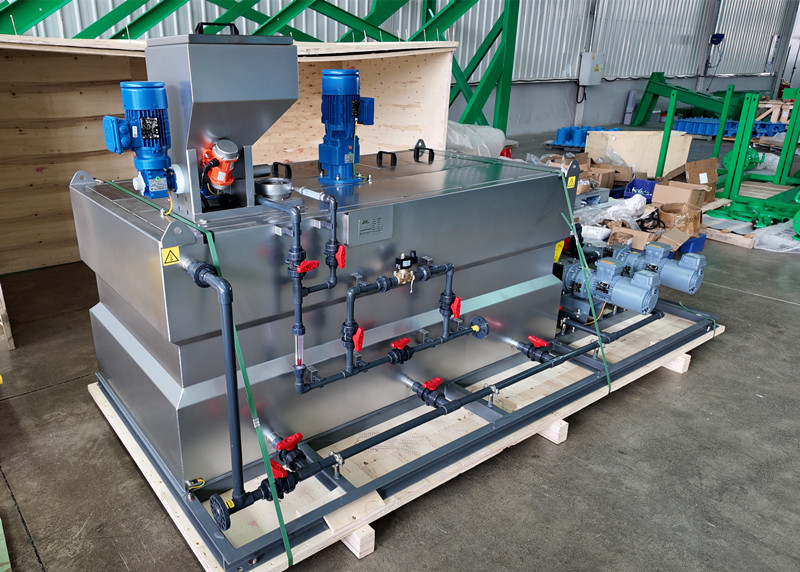
Finally, the system integration aspect is crucial for the client’s ease of use. The centrifuge is not a standalone unit but the heart of a pre-engineered, skid-mounted system. This includes the 1000L polymer preparation and dosing units, feed pumps, control panels, and piping, all assembled and tested at the factory. This modular “plug-and-play” approach drastically reduces on-site installation time and complexity, a significant advantage for international projects. The entire system can be monitored and controlled via a PLC, which manages the dosing pumps and centrifuge parameters, ensuring synchronized and efficient operation.
In summary, the GN-14 inch sludge dewatering centrifuge, integrated with a robust 1000L chemical dosing system, operates on the principle of centrifugal sedimentation and continuous scroll conveyance. Its performance is characterized by high dewatering efficiency, excellent solids recovery, precise operational control via VFD, robust construction for longevity, and seamless system integration. This combination provides a reliable, efficient, and adaptable solution for sludge volume reduction, meeting the stringent demands of modern wastewater treatment facilities in Southeast Asia and beyond.