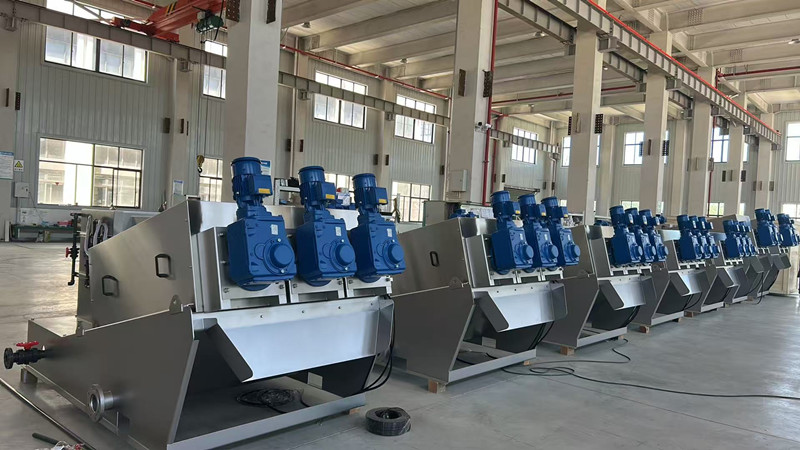
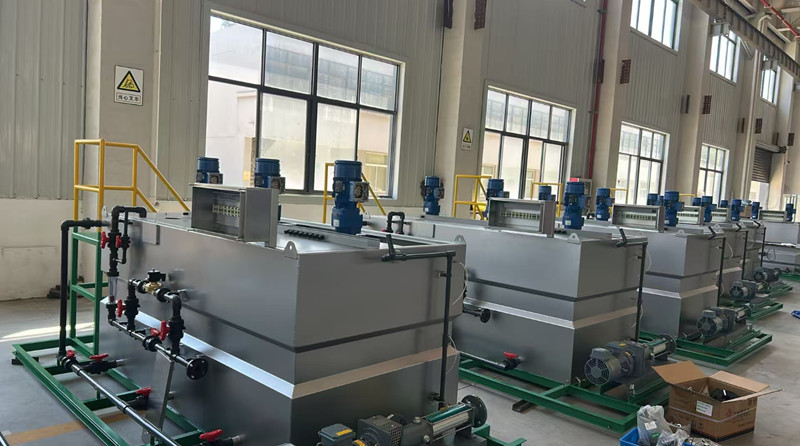
A shipment of screw press dewatering machines and flocculant dosing units has been dispatched to an overseas client. This delivery includes the GNDL303 and GNDL304 models of the spiral screw dewatering machine, along with the GNSJY2000L and GNSJY3000L models of the fully automatic flocculant dosing system. These units represent core equipment for modern sludge dewatering and wastewater treatment processes.
The spiral screw dewatering machine, often called a screw press, operates on a continuous mechanical dewatering principle. It consists of a series of fixed and moving circular rings stacked around a central rotating screw shaft. As the screw rotates, it conveys sludge from the inlet towards the discharge end. The key mechanical action is the progressive compression of the sludge as it moves through the gradually narrowing gaps between the fixed and moving rings. This design allows for continuous operation with minimal requirement for pre-concentration of the sludge feed. The GNDL303 and GNDL304 models are engineered for efficiency and reliability, featuring robust construction of the spiral shaft and rings to withstand abrasive materials, integrated spray systems for self-cleaning, and variable frequency drives for precise control of the screw speed and back pressure. This control directly influences the final cake dryness and processing capacity. Their operational advantages include relatively low energy consumption, reduced noise levels, and a compact footprint, making them suitable for municipal wastewater treatment plants and various industrial applications, including food processing and chemical manufacturing.
The effectiveness of the spiral screw dewatering machine is intrinsically linked to optimal sludge conditioning, which is the primary function of the flocculant dosing system. The GNSJY2000L and GNSJY3000L units are integrated systems designed for the automated preparation and injection of chemical agents, primarily polyelectrolytes like polyacrylamide (PAM). The mechanical and control principles of these systems ensure consistent and accurate dosing, which is critical for forming stable flocs that release water efficiently during dewatering.
The working process of the dosing unit involves several stages. First, the dry polymer powder is fed into a wetting funnel, where it is immediately dispersed into a stream of water to prevent the formation of sticky agglomerates or “fish eyes.” This pre-mixed solution then enters a maturation tank equipped with a mechanical agitator. The agitation is carefully controlled to provide sufficient mixing for complete dissolution without excessive shear that could degrade the long polymer chains, reducing their effectiveness. From the maturation tank, the fully prepared stock solution is transferred to a day tank. The heart of the dosing control is the metering pump, typically a diaphragm or peristaltic type, which draws from the day tank and injects the precise volume of polymer solution into the sludge stream. The dosing rate is automatically adjusted by a Programmable Logic Controller (PLC) based on signals from flow meters measuring the incoming sludge. Some advanced systems incorporate a feedback loop from a sludge consistency analyzer to fine-tune the polymer dose for varying sludge characteristics, optimizing consumption and performance.
The synergy between the dosing unit and the dewatering machine is fundamental. The dosing system prepares the sludge by binding fine particles into larger, stronger flocs. These conditioned flocs then enter the spiral press. The mechanical action of the screw transports and compresses the flocculated sludge. The well-formed flocs are robust enough to withstand the shear forces within the press while readily releasing bound water through the gaps between the rings. The separated water, or filtrate, drains through these gaps, while the solid fraction is compacted into a dewatered cake for disposal. An improperly dosed sludge—either under-conditioned or over-conditioned—will lead to poor dewatering performance, manifesting as excessively wet cake, cloudy filtrate, or high polymer consumption.
The integration of these two systems into a cohesive package for export involves careful engineering. Control panels are often unified, allowing operators to monitor and adjust both the polymer preparation/dosing cycle and the screw press operation from a single interface. Safety interlocks are implemented; for example, the spiral press may be prevented from starting if the dosing unit signals a low-level condition in the polymer day tank. For international clients, these systems are equipped with comprehensive documentation, including P&ID (Piping and Instrumentation Diagram), electrical schematics, and operation manuals in English, facilitating correct installation and maintenance.
The dispatch of the GNDL series spiral presses and GNSJY series dosing units underscores their role as a proven, efficient, and automated solution for sludge volume reduction. Their combined mechanical principles—precise chemical conditioning followed by continuous physical compression—deliver reliable dewatering performance essential for meeting the operational and environmental compliance standards of wastewater treatment facilities worldwide.